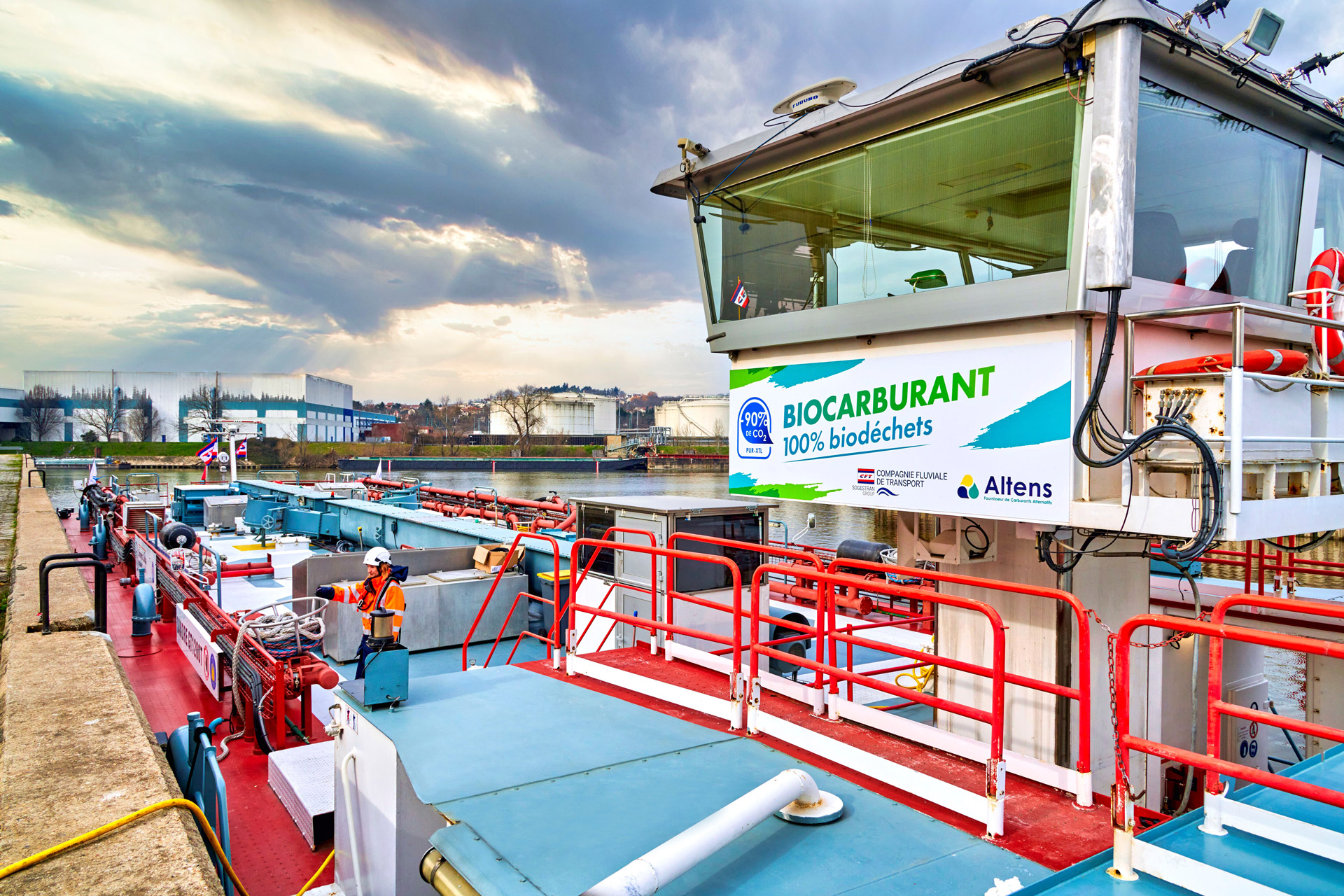
Derived 100% from used cooking oils, B100 for the maritime sector supports shipowners in decarbonizing their fleets, with a reduction of at least 88% in CO₂ emissions.
From oil to fuel
B100 Maritime is composed of 100% Used Cooking Oil Methyl Ester (UCOME), a renewable biofuel produced from used cooking oils. Manufactured in France from ISCC-certified raw materials, it meets the traceability and sustainability requirements of the maritime sector and contributes to reducing the carbon footprint of vessels.
Shipowners, sail with low-carbon energies
With ALTENS biofuels, we enable you to:
improve your CII (Carbon Intensity Indicator) rating
meet the 6% greenhouse gas reduction targets for 2030 set by FuelEU Maritime
meet the emission quotas implemented in 2024
navigate while respecting emission limits for SOx sulfur and NOx nitrogen oxide air pollutants
-80% CO2eq
with B100 fuel compared to conventional MGO.
An immediate solution to improve your CII and your SCOPE 1 to 3 reporting.
01
Project scoping
Support for your CO2eq strategy
Understanding your CO2eq emission reduction needs
Modeling your CO2eq emissions across your supply chain
Calculating your CII rating
Determining an action plan consistent with the desired CO2eq reduction trajectory
Support for your cost strategy
Proposing levers to smooth the additional costs associated with purchasing biofuels
02
Delivery and bunkering
Preparation of the blend (e.g., B30, B50, B100) based on the shipowner’s objective
Fuel coloring in our depots
Product delivery by truck to all ports (ship-to-ship bunkering)
03
CO2 emission monitoring and reporting
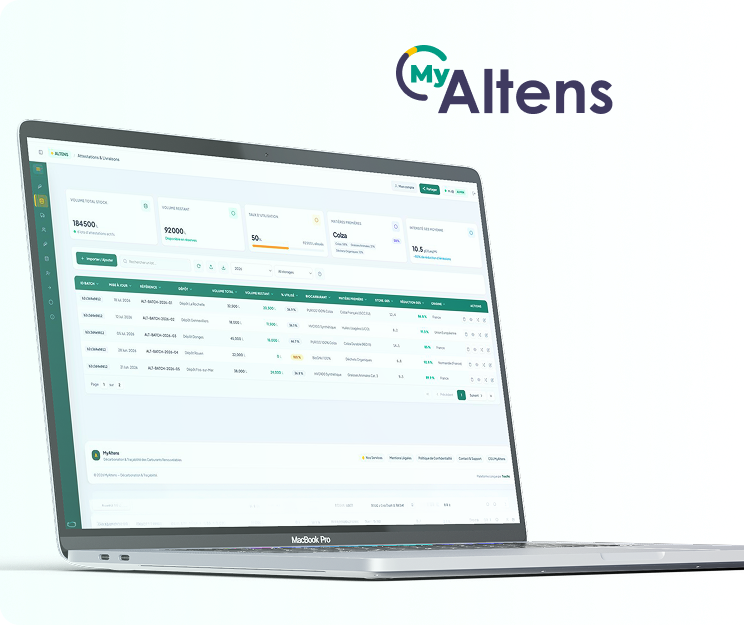
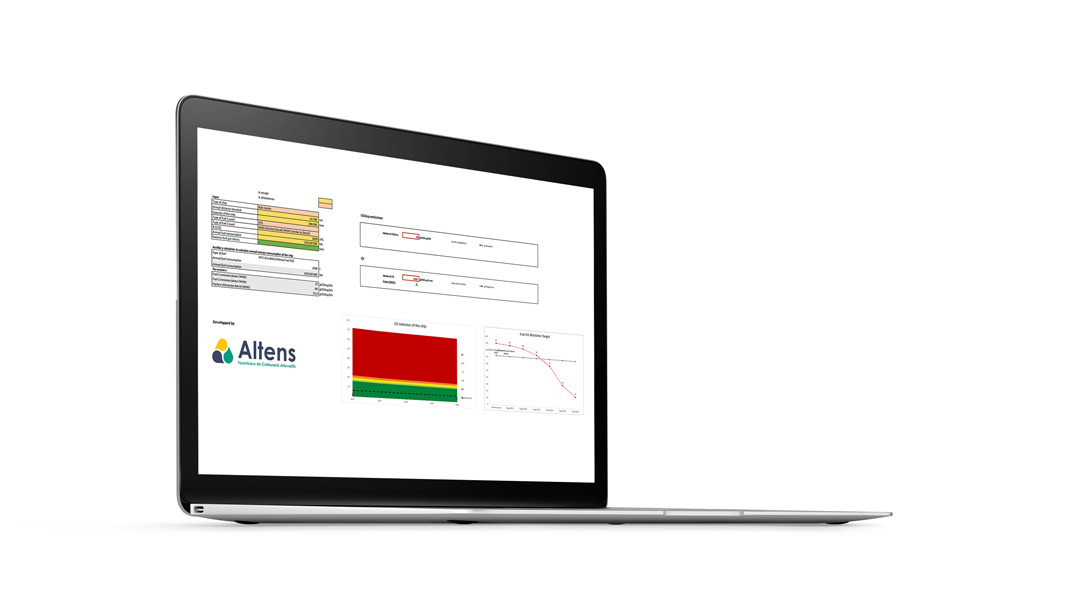
Track and control your CO2eq emissions with MyAltens
Consolidate and report your emissions
Allocate your CO2 emission savings to your customers
Partenariats & événements
À Euromaritime, Altens présente ses solutions pour la décarbonation du transport maritime
Acteur engagé dans la transition énergétique, Altens propose une large offre de solutions bas-carbone pour verdir la filière maritime. Au salon Euromaritime, stand A19, Altens expose le PUR-BioM : une gamme de biocarburants qui réduit considérablement, et dès maintenant, les émissions de CO2.
MyAltens, a tool for traceability and transparency.
In a world where your clients, investors, and regulations demand proof, MyAltens tracks every liter delivered, every ton of CO₂ avoided, every certificate generated.
Ready for your CSR report, your tender, your CSRD audit. No manual entry. No omissions.
Our platform facilitates the monitoring of environmental information to support companies in their climate strategy.
Together, let's decarbonize maritime transport
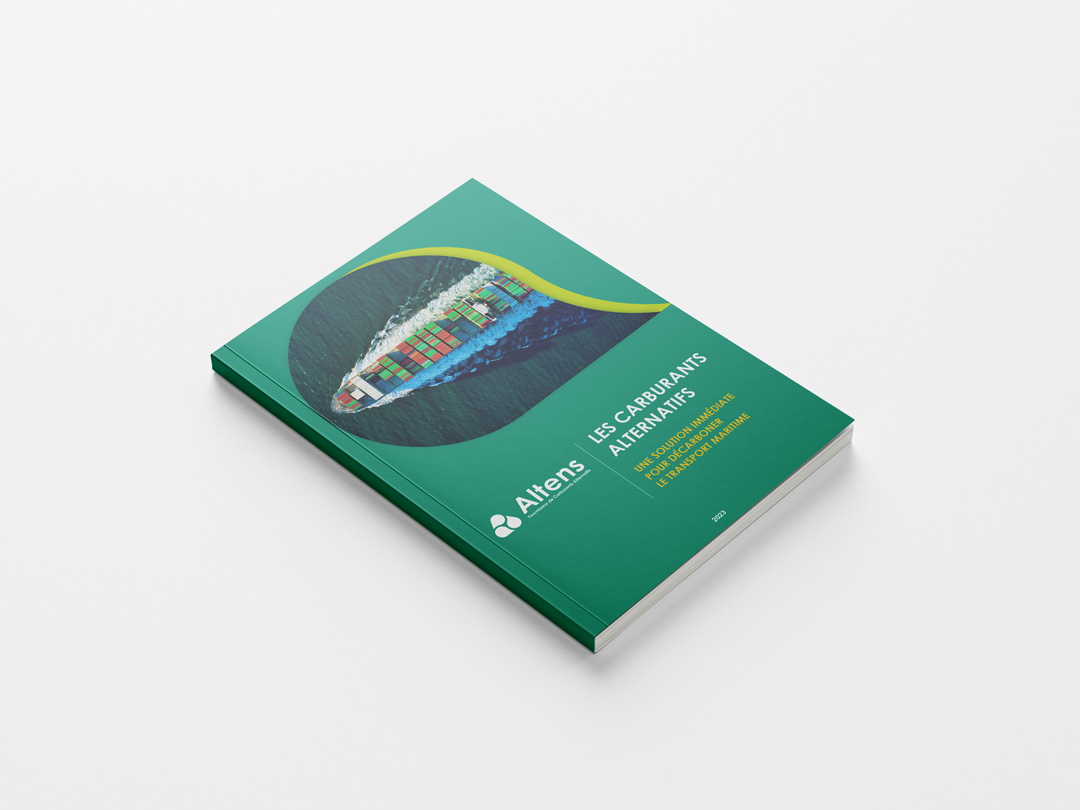
Altens White Paper
The white paper on decarbonizing maritime transport with biofuels.
It is an alternative fuel that is completely interchangeable and compatible with the conventional fuel (usually petroleum-derived) it replaces. A “drop-in fuel” requires no adaptation of the fuel distribution network, nor of the fuel supply systems of vehicles or equipment. This fuel can be used “as is” in vehicles and engines currently running on the fuel it replaces.
For HVO100, the corresponding standard is EN 15940, which covers all synthetic fuels. This standard is very similar
to standard diesel (EN 590) except for density (XtL fuels are less dense) and a much higher Cetane rating than traditional diesel, which allows for better fuel combustion and therefore fewer unburned particles, less engine fouling, etc.
For B100, it is the European standard EN 14214.
During MEPC-80 (July 3-7, 2023), interim guidelines applicable from October 1, 2023, indicate that, within the framework of implementing DCS and CII requirements, biofuels that have been certified by an international certification system meeting its sustainability criteria can be assigned an emission factor calculated over the entire fuel life cycle, i.e., Well to Wake. In this case, Altens biofuels do indeed allow for a lower CII rating.
The Fatty Acid Methyl Esters that make up 30% of B30 are manufactured from Used Cooking Oils (UCO).
Regarding HVO100, we have chosen to source only HVO produced exclusively from waste and residues such as used cooking oils, animal fats, and other industrial waste.
In any case, HVO100 and B30 have no impact on arable land.
Furthermore, PALM OIL, PFAD, and SOY have been banned since 2020 for biofuel use in France. Thus, none of these raw materials are used in Altens biofuels.
All raw materials are ISCC certified, an international sustainability standard recognized by the European Commission. ALTENS pays the utmost attention to the traceability of raw materials and ensures compliance with current sustainability rules.
The traceability and sustainability of raw materials and our biofuels are a requirement at the heart of the company’s performance. Thus, all biofuels distributed by ALTENS are tracked, audited, and certified sustainable. The objective of this certification is to demonstrate, through audits conducted by independent third-party organizations, compliance with the sustainability criteria set by the European directive.
The applicable regulation is as follows: in SECA (Sulphur Emission Control Area) zones, ships must use a fuel with a sulfur content not exceeding 0.1% (m/m).
HVO100 is a fuel with a sulfur content not exceeding 0.0005 kg/kg. Thus, it can be used anywhere in the world. B100 is also well below 0.1% (around 0.07%).
From now on, blends not exceeding 30% biofuel by volume can be treated as traditional fuels. Blends containing more than 30% biofuel must undergo an examination by an authorized classification society and receive flag state approval to ensure that NOx emissions remain compliant with applicable regulations.
Votre vie privée compte
Nous utilisons des cookies afin d’assurer le bon fonctionnement de notre site, mesurer son audience et améliorer votre expérience. Vous pouvez accepter, refuser ou personnaliser vos choix à tout moment.
Cookies fonctionnels
Always active
Nécessaires au bon fonctionnement du site et de ses fonctionnalités. Ces cookies ne peuvent pas être désactivés.
Préférences
L’accès ou le stockage technique est nécessaire dans la finalité d’intérêt légitime de stocker des préférences qui ne sont pas demandées par l’abonné ou l’internaute.
Cookies statistiques
Nous permettent de comprendre comment le site est utilisé afin d’en mesurer l’audience et d’améliorer ses performances.Le stockage ou l’accès technique qui est utilisé exclusivement dans des finalités statistiques anonymes. En l’absence d’une assignation à comparaître, d’une conformité volontaire de la part de votre fournisseur d’accès à internet ou d’enregistrements supplémentaires provenant d’une tierce partie, les informations stockées ou extraites à cette seule fin ne peuvent généralement pas être utilisées pour vous identifier.
Marketing
L’accès ou le stockage technique est nécessaire pour créer des profils d’internautes afin d’envoyer des publicités, ou pour suivre l’utilisateur sur un site web ou sur plusieurs sites web ayant des finalités marketing similaires.